5 Calling Card Tricks That Eat Your Minutes (and How to Spot Them)
Connection fees, maintenance fees, rounding, surcharges and 'up to' minutes: how prepaid calling cards and PIN-less apps shrink what you paid for, with a checklist to compare any calling service.
On this page (8 sections)
Calling cards rarely cheat you on the advertised per-minute rate. They cheat you on everything around it: a fee each time you connect, a weekly fee for holding a balance, rounding every call up to several minutes, surcharges depending on how you dial in, and "up to" minute counts that only apply in ideal conditions. Here are the five tricks, how to spot each one in the small print, and a checklist you can use on any calling service, card or app.
Regulators have documented these practices. The FCC's consumer guide to prepaid phone cards and the Minnesota Attorney General's calling card advice both warn about hang-up fees, maintenance fees and surcharges. The US Federal Trade Commission has acted against card distributors whose cards delivered far fewer minutes than advertised.
1. Connection or "hang-up" fees
How it works: a fixed charge every time a call connects, or every time you hang up. The amount is listed on the back of the card, or sometimes only on the provider's website.
Effect: with a 1-cent-a-minute rate and, say, a 50-cent connection fee, a two-minute call costs 52 cents, and a $10 card is gone after about twenty short calls.
How to spot it: look for "connection fee", "disconnect fee", "hang-up fee", "post-call fee" or "service charge per call".
2. Maintenance fees
How it works: once you've made your first call, the card deducts a fee at fixed intervals, often weekly, whether or not you use it.
Effect: you make one call, put the card away for a month, and find it empty when you try to use it again.
How to spot it: "weekly fee", "service fee after first use", "balance maintenance", "administrative fee". Also check the expiry date, since many cards expire 30 to 90 days after first use.
3. Rounding up in big blocks
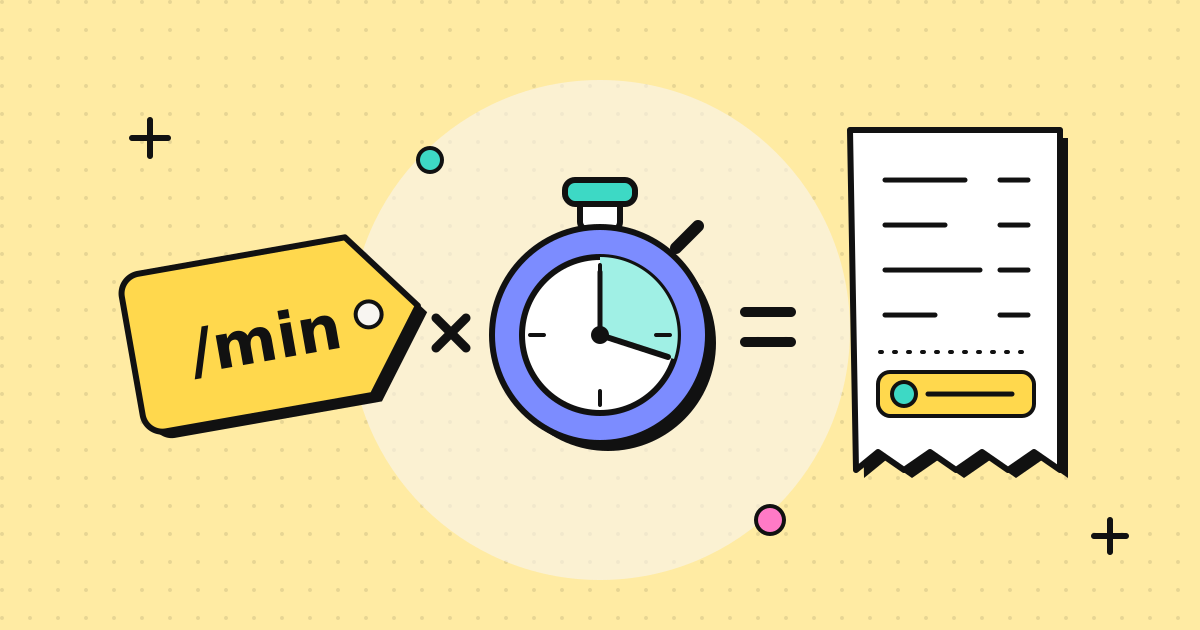
How it works: calls are billed in blocks rather than by the second. Per-minute rounding is common across the industry. Some cards round to 3-minute blocks, so a 20-second call that reaches voicemail is billed as 3 minutes.
Effect: short calls cost far more than the headline rate suggests.
How to spot it: "billed in 3-minute increments", "rounded up", "minimum charge per call".
To be open about our own billing: EzyRing bills per minute, rounded up to the next minute, which is standard for international calls but isn't per-second billing. If most of your calls are under a minute, a per-second provider may suit you better.
4. Access-number surcharges
How it works: with physical cards and PIN-based services, you first dial an access number and then the destination. Using the toll-free access number instead of a local one, or dialling from a payphone or hotel phone, adds a surcharge per call or per minute.
Effect: the same card costs more depending on which access number you used.
How to spot it: "toll-free access surcharge", "payphone surcharge", "different rates apply for 800 access".
5. "Up to" minutes
How it works: the poster says "up to 1,000 minutes for $5". That figure assumes one continuous call, to a specific landline city, through a local access number, with no fees applied.
Effect: with normal use (several calls, to mobiles, with fees and rounding) you get a small fraction of the advertised minutes.
How to spot it: the words "up to", "minutes may vary", or a landline-only rate shown in large print while mobile rates are hidden.
The same tricks in apps
These practices didn't disappear when cards moved online. Watch for:
- Auto-renewing "international bundles" that charge monthly whether you call or not
- Credit that expires after a period of inactivity
- Bonus credit that can only be used on certain destinations
- Mobile rates not shown until after you've paid
A checklist for any calling service
Before you pay, find the answer to each of these. If you can't, take that as a warning.
| Question | What a fair answer looks like |
|---|---|
| What's the rate to the exact line type (mobile or landline) I'll call? | Shown before you buy and before you dial |
| Is there a per-call, connection or hang-up fee? | Stated plainly, ideally none |
| Is there a maintenance or inactivity fee? | None |
| Does credit expire? | Ideally never |
| How are calls rounded? | Stated plainly (per second or per minute) |
| Is it a subscription? | Clear opt-in, easy to cancel |
| What number does the other person see? | A number they'll recognise |
How EzyRing answers those questions
We built EzyRing to give clear answers to every row of that checklist:
- The per-minute rate shows in the dialer before you call, and the rates page lists every country.
- No subscription and no maintenance fees, and credit doesn't expire.
- Per-minute billing, rounded up, as described above. Calls that don't connect are free.
- A running cost shows during the call, which ends before your credit runs out.
- Calls go out with a number you've verified as yours as caller ID, so family recognise it. How it displays depends on the recipient's carrier (details).
Before you buy anything, check the rate to the country you call most, for example cheap calls to Bangladesh or cheap calls to Ghana. Packs start at $5.
More on the price itself: international call rates explained. For other ways to keep costs down: what's actually free when calling from a browser.
Frequently asked questions
Are international calling cards a scam?
Not all of them, but the industry has a long record of misleading minute claims and fees in the small print. US regulators have acted against card companies whose cards delivered far fewer minutes than advertised. Read the fee section before you buy, and test with the smallest card first.
What is a maintenance fee on a calling card?
A charge taken from your balance at regular intervals, often weekly, once you have used the card for the first time. It drains the card even if you don't make calls, so a balance can reach zero while the card sits in your wallet.
How is call rounding different from per-second billing?
Per-second billing charges for exactly the time you talked. Rounding charges in blocks: per minute rounds a 61-second call up to 2 minutes, and some cards use 3-minute blocks, so a 20-second call costs 3 minutes.
How does EzyRing bill calls?
Per minute, rounded up to the next full minute, at the rate shown before you dial. There is no subscription, no maintenance fee, and credit doesn't expire. Calls that don't connect aren't charged.
Written by
EzyRing Team
The team that builds EzyRing, a browser phone for calling landlines and mobiles abroad, made in Madrid.
Ready to make the call?
Sign-up is free. You only pay for the minutes you use.
Prepaid, no subscription
Top up from $5. Credit doesn't expire, and nothing renews.
Rate shown before you call
You see the per-minute price before dialling and the running cost during the call.
Caller ID from a number you verify
Verify a number you own once; calls go out with it. Display depends on the recipient's carrier.
Calls aren't recorded. EzyRing is not for emergency calls.