International Call Rates Explained: What You Actually Pay For
Why calling a mobile in one country costs more than a landline in another, how per-minute billing and rounding work, and how to work out a call's real cost before you dial.
On this page (6 sections)
An international call rate is a per-minute price, and it depends mostly on two things: the destination country and whether you're calling a mobile or a landline. The rest of the price comes from how the provider bills (per minute or per second, and how it rounds) and from any fees added per call or per month. If you know those four things, you can work out what a call will cost before you dial.
This page covers each of them, with how EzyRing handles it in plain terms.
What a per-minute rate is made of
When you call a phone number abroad, three parties handle the call:
- Your provider, which takes the call from your browser or phone.
- Transit carriers, which carry it across borders.
- The terminating carrier, which owns the number you called and rings the phone.
The terminating carrier charges for every minute it delivers, and that charge is the biggest part of the rate. It's also why rates vary so much. A country with heavy competition and regulated wholesale prices is cheap to call. A country where one or two operators set high termination fees is expensive, whichever provider you use.
The four things that change the price
1. Destination country
This has the biggest effect, and the gap between the cheapest and most expensive countries can be large. Never assume that a country close to you will be cheap.
2. Mobile or landline
The same country can have two rates. In many countries mobile operators charge more to terminate calls, so calling a mobile costs more than calling a landline. Some countries also have separate rates for particular operators or number ranges. The rates page lists the line types separately.
3. Billing increment
Providers bill in different units:
- Per minute, rounded up. A 2-minute-10-second call is billed as 3 minutes.
- Per second. You pay for exactly 130 seconds.
- A minimum first block. For example the first 60 seconds, then per second after that.
On long calls the difference is small. If you make lots of 20-second calls, such as quick check-ins or calls that hit voicemail, per-minute rounding adds noticeably to the bill.
4. Extra fees
Older calling cards earned much of their margin this way: connection fees, "hang-up" fees, weekly maintenance fees and credit that expired. Some app subscriptions do something similar with monthly fees or bundles that reset every month. Our calling card fees guide covers each one.
How EzyRing prices calls
Here's how each factor works on EzyRing:
| Factor | How it works |
|---|---|
| Rate | Per destination and line type, synced weekly from the carrier |
| When you see it | In the dialer, before you press call |
| Billing | Per minute, rounded up to the next full minute |
| Calls that don't connect | Not charged |
| During the call | A running cost shows in the dialer |
| Running low | The call ends before your credit runs out |
| Subscription | None |
| Credit expiry | Credit doesn't expire |
| Packs | $5, $20 (gives $21) or $50 (gives $55) |
For the cheapest destinations, rates start at about $0.025 a minute. Because rates are synced every week, we don't print per-country prices in articles, since they'd go out of date. The rates page and each country page, such as cheap calls to India or cheap calls to Nigeria, always show the current rate.
Working out a call's cost yourself
Use this formula:
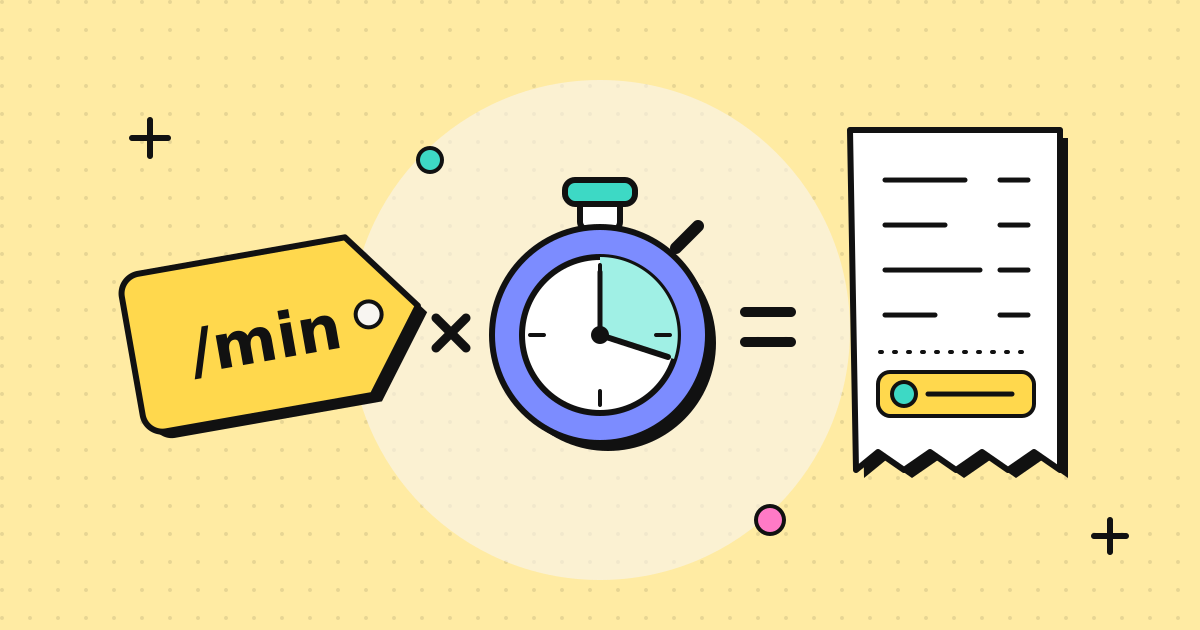
Cost = rate per minute x minutes (rounded up)
As an example with round numbers: if the dialer shows $0.10 a minute and you talk for 14 minutes 20 seconds, you're billed for 15 minutes, so $1.50. Look up the real rate for your number on the rates page and use that.
The minimum balance to start a call is one minute at that number's rate. Once you're connected, the dialer shows how long your balance will last.
Ways to pay less
- Call the landline if both are available. Where the mobile rate is higher, calling a family member's home line or an office's landline costs less.
- Group short calls together. With per-minute rounding, one 10-minute call costs less than five 90-second calls.
- Avoid calling toll-free numbers from abroad. Many 0800 and 1-800 numbers can't be reached internationally. Look for the organisation's international number instead, or follow our guide to calling from a browser.
- Use free apps when the other person has them. WhatsApp-to-WhatsApp calls cost nothing. Pay for minutes only when you need to reach a real phone number, such as a landline, a bank or a relative without a smartphone.
- Buy the pack that matches what you'll use. Larger packs add bonus credit, but credit doesn't expire either way, so there's no reason to buy more than you expect to use.
Comparing providers fairly
When you compare rates, check the same things for every provider:
- The rate for the exact line type you'll call (mobile or landline).
- The billing increment and any minimum charge.
- Per-call, monthly or maintenance fees.
- Credit expiry.
- Caller ID: what number the other person will see. A cheap call that nobody answers costs you more in the end. Our verified caller ID page explains why this matters, and the pricing page covers EzyRing's packs.
Rates are only one part of choosing a provider. For the broader comparison of free and paid options, see what's actually free when calling from a browser.
Frequently asked questions
Why does calling a mobile cost more than a landline in some countries?
The carrier that owns the number charges a termination fee for every minute it carries your call. In many countries mobile operators charge more to terminate calls than landline operators, so the per-minute rate for mobiles is higher. In others the two are almost the same.
How is an international call billed on EzyRing?
Per minute, rounded up to the next full minute, at the rate the dialer shows before you call. A call that never connects costs nothing. A call answered by voicemail counts as connected, because the destination carrier bills it.
Do EzyRing rates change?
Yes. Per-minute rates are synced weekly from the carrier, so they can move up or down. The rate shown in the dialer before you press call is the one that applies to that call.
Are there connection fees or monthly fees?
There is no subscription and no monthly fee. Credit packs start at $5 and the credit doesn't expire. Calls are charged at the per-minute rate shown before you dial.
What is the cheapest country to call?
It changes as carrier prices move. The cheapest destinations currently start from about $0.025 a minute. The rates page lists every country and line type, so check the specific number you plan to call.
Written by
EzyRing Team
The team that builds EzyRing, a browser phone for calling landlines and mobiles abroad, made in Madrid.
Ready to make the call?
Sign-up is free. You only pay for the minutes you use.
Prepaid, no subscription
Top up from $5. Credit doesn't expire, and nothing renews.
Rate shown before you call
You see the per-minute price before dialling and the running cost during the call.
Caller ID from a number you verify
Verify a number you own once; calls go out with it. Display depends on the recipient's carrier.
Calls aren't recorded. EzyRing is not for emergency calls.