Unknown Caller vs No Caller ID: What Each One Means
'No Caller ID' means the caller chose to hide their number. 'Unknown' means the number got lost or removed on the way. Here's why it happens, especially on international calls, and what to do about each.
On this page (6 sections)
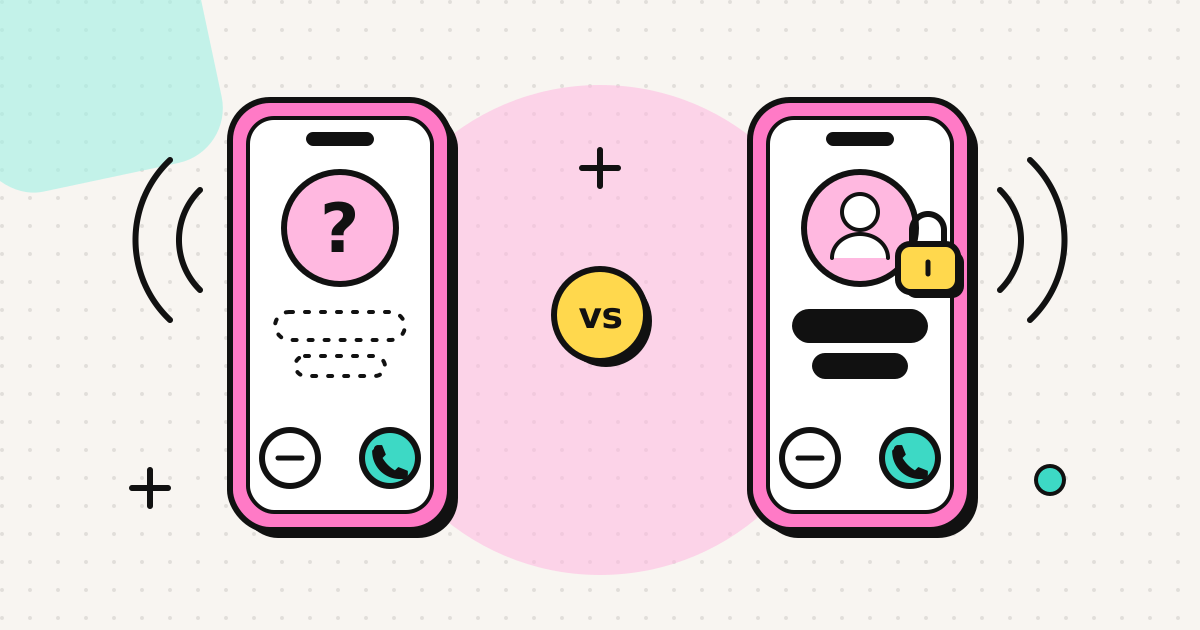
No Caller ID means the caller chose to hide their number. Their network knew it and withheld it on purpose. Unknown (or "Unavailable") means the number didn't arrive: it was dropped, mangled or removed somewhere along the route, often on international calls. Either way your phone can't show or redial a number, but the reasons differ, and so does what you can do about it.
Side by side
| No Caller ID | Unknown | |
|---|---|---|
| Also shown as | Private, Withheld, Blocked, Restricted | Unavailable, Out of area, sometimes a garbled number |
| Who caused it | The caller, on purpose | The network, usually not on purpose |
| Does the network know the number | Yes, it's flagged as private | Often not, or not in a usable form |
| Typical sources | *67, 141, #31#, "Show My Caller ID" off; hospital and police switchboards |
International routes, some VoIP systems, old exchanges, anti-spoofing rules |
| Can you redial | No | No |
| Can police get it from the carrier | Yes, with legal process | Sometimes only partly |
What "No Caller ID" means
The caller's network sent their number with a privacy flag ("presentation restricted"), and your network obeyed it. The caller did one of these:
- dialled a blocking code first:
*67(US and Canada),141(UK),#31#(most mobile networks elsewhere) - turned off Show My Caller ID on iPhone, or set Hide number on Android
- asked their carrier to block their caller ID permanently
- called from a switchboard that withholds by default, which is common for hospitals, GP surgeries, police and some employers
For how this is done, see how to call with No Caller ID. If you're on the receiving end, see how to find out who a No Caller ID is.
What "Unknown" means
Your network received the call without a usable number. Common reasons:
International routing
A call from abroad can pass through several carriers before it reaches yours. If one of them doesn't pass the number on correctly, it's lost. This happens more on low-cost wholesale routes.
Anti-spoofing rules
Regulators now tell carriers to withhold some numbers on purpose. The UK regulator Ofcom has guidance requiring providers to block or withhold calls from abroad that present certain UK numbers, and it has decided to withhold UK mobile numbers on calls from abroad unless they can be verified, because scammers so often fake them. Other countries have similar rules. The result is that a perfectly genuine relative calling from abroad can show up as withheld or unknown.
Some VoIP and business systems
A badly configured phone system, or a cheap calling app, may not send any number, or may send it in a format your network rejects.
Old exchanges and payphones
These are rarer now, but some older equipment doesn't send caller ID at all.
Labels that aren't either
- "Spam Likely" / "Potential Spam" / "Scam Likely": the number did arrive, and your carrier or phone has flagged it based on call patterns.
- "International" or a country name with no number: some carriers show this when the number is withheld on an incoming international call.
- A name with no number: in the US, the name comes from a lookup database (CNAM), and can be wrong or faked.
What to do with each
- Let it go to voicemail. Genuine callers, including relatives, clinics and couriers, usually leave a message and a callback number.
- Use screening instead of blocking if you're expecting an important call. iOS 26 can ask unknown callers for their name and reason before ringing, and Pixel phones have Call Screen in supported countries.
- Block hidden numbers only if you're sure nobody important withholds. See how to block No Caller ID calls.
- Keep a log if the calls are persistent or threatening, and report them to the police.
When your own calls show as Unknown
If family abroad say your calls come up as "Unknown" or with a strange number, the cause is usually the route or the service you're calling with. Calls that arrive without a recognisable number get screened out, so this matters.
Here's what helps:
- Call through a service that sends a real number you own as caller ID, not a random or shared one.
- Expect some countries to withhold a number from their own country when it arrives from abroad. If you're calling the UK with a UK mobile number from abroad, that's increasingly likely. Using a number from a different country, or your landline, can work better.
- Ask your relatives to save the number you call from, so it rings through their unknown-caller filters.
EzyRing is built around the first point. It's a browser phone where you verify a number you own once (we call it, you key in a code), and international calls go out with that number as caller ID. The recipient's carrier still decides what's displayed, so cross-border calls usually show it, but with the exceptions above. The verified caller ID page lists them. Rates for each country are on the rates page.
Frequently asked questions
What is the difference between Unknown and No Caller ID?
No Caller ID (also Private, Withheld or Blocked) means the caller deliberately hid their number, for example with *67 or 141. Unknown (or Unavailable) means the number didn't reach your phone, usually because a network along the route dropped it or replaced it.
Why do international calls show as Unknown?
International calls pass through several carriers. Some routes don't carry the number properly, and some countries deliberately withhold numbers on calls from abroad that look domestic, as an anti-spoofing measure. Either way your phone receives no usable number.
Which one is more likely to be a scam?
Neither label tells you on its own. Scammers use both, and so do hospitals, police and relatives abroad. Let unknown calls go to voicemail; genuine callers usually leave a name and a number.
Can I call back an Unknown or No Caller ID call?
No. In both cases your phone never received a number, so there is nothing to redial, and call-return services like *69 or 1471 can't help.
Written by
EzyRing Team
The team that builds EzyRing, a browser phone for calling landlines and mobiles abroad, made in Madrid.
Ready to make the call?
Sign-up is free. You only pay for the minutes you use.
Prepaid, no subscription
Top up from $5. Credit doesn't expire, and nothing renews.
Rate shown before you call
You see the per-minute price before dialling and the running cost during the call.
Caller ID from a number you verify
Verify a number you own once; calls go out with it. Display depends on the recipient's carrier.
Calls aren't recorded. EzyRing is not for emergency calls.